
Google's New Code Wiki Solves Software's Most Expensive Problem

Any developer will tell you that a significant portion of their time isn’t spent writing new, innovative features. Instead, it’s consumed by the painstaking process of reading and deciphering existing code. This universal challenge represents a massive, often invisible, drain on productivity and resources across the industry.
Reading existing code is one of the biggest, most expensive bottlenecks in software development.
To address this critical issue, Google has introduced ‘Code Wiki,’ a platform that extends the company’s core mission of organizing information to one of development’s most challenging domains: unlocking the vital knowledge buried in source code. Here are the key takeaways from the launch.
1. Documentation That’s Never Out of Date Again
The core feature of Code Wiki is its ability to create “living documentation.” The system automatically scans an entire codebase and regenerates its structured wiki after every single change is committed. This ensures that the documentation always reflects the exact current state of the code.
This is a profound shift from the traditional model of software documentation. Static, manually updated documents inevitably fall out of sync with the code they describe, quickly becoming obsolete and, worse, untrustworthy. Code Wiki replaces this fragile process with a reliable, automated system where the docs evolve in lockstep with the code itself.
2. An AI Expert That Knows Your Repository Inside and Out
Integrated within the platform is a Gemini-powered chat agent, but this is not a generic AI assistant but an expert model that knows your repository end-to-end. Its key distinction is its deep, contextual knowledge derived directly from the codebase it’s analyzing.
The chat agent uses the continuously updated wiki of the specific repository as its knowledge base. This allows it to answer highly specific, context-aware questions about that particular project. Developers can ask about complex modules or intricate logic and receive answers grounded in the reality of their own code, instantly bridging the gap between learning about the code and actively exploring it.
3. Code Becomes Interactive, Not Just Readable
Code Wiki’s most significant innovation may be how it merges reading and exploring into a single, seamless workflow, transforming documentation from a passive reference into an interactive tool. It achieves this through two key features:
• Every explanation in the wiki is hyperlinked directly to the relevant code files, classes, and functions, allowing users to jump from high-level concepts to the exact implementation with a single click.
• The system automatically generates always-current architecture, class, and sequence diagrams to help developers visualize complex relationships and data flows as they exist in the latest version of the code.
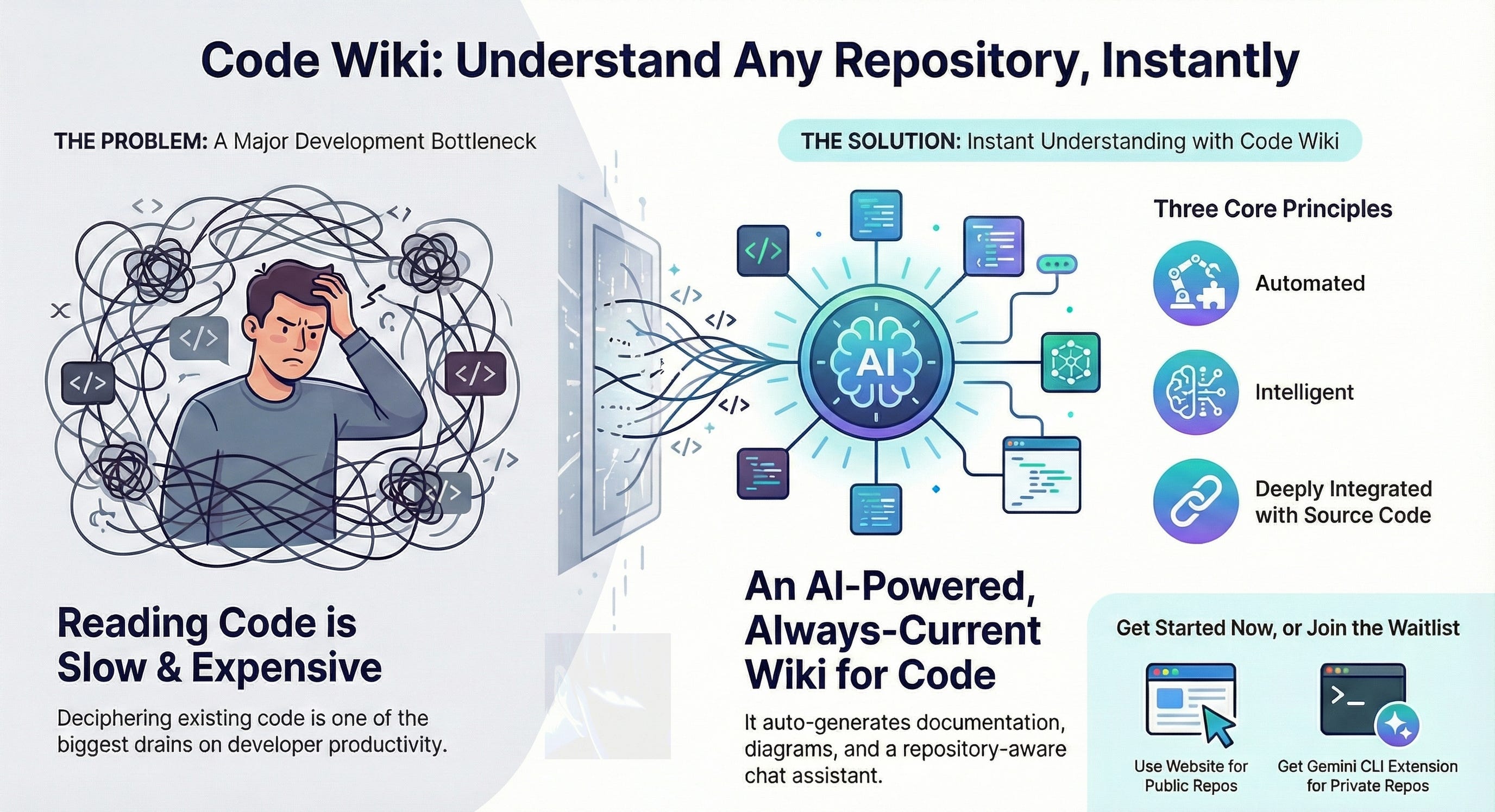
The impact of this interactivity is designed to be immediate and significant. As Google states, the goal is a world where “new contributors can make their first commit on Day 1, while senior developers can understand new libraries in minutes, not days.”
While the initial public preview on the Code Wiki website focuses on public repositories, a solution for the often-undocumented world of private, internal codebases is on the horizon. Google announced it is building the “Gemini CLI extension for Code Wiki,” which will allow development teams to run the same powerful system locally and securely on their internal repositories. This is positioned as a game-changer for companies struggling with the massive hurdle of understanding their own legacy code, especially when the original authors are no longer available.
Code Wiki represents a clear effort to tackle one of software development’s most persistent and costly problems. The goal is to fundamentally shift how developers spend their time—away from the tedious work of deciphering existing systems and toward the creative work of building what’s next. This positions Code Wiki not merely as a documentation tool but as a foundational piece in the emerging category of AI-native development environments, where understanding is a service, not a task.
Your Guide to Instant Code Comprehension
In the world of software development, one of the most significant and time-consuming challenges is simply understanding code that has already been written. As Google’s experts put it:
Reading existing code is one of the biggest, most expensive bottlenecks in software development.
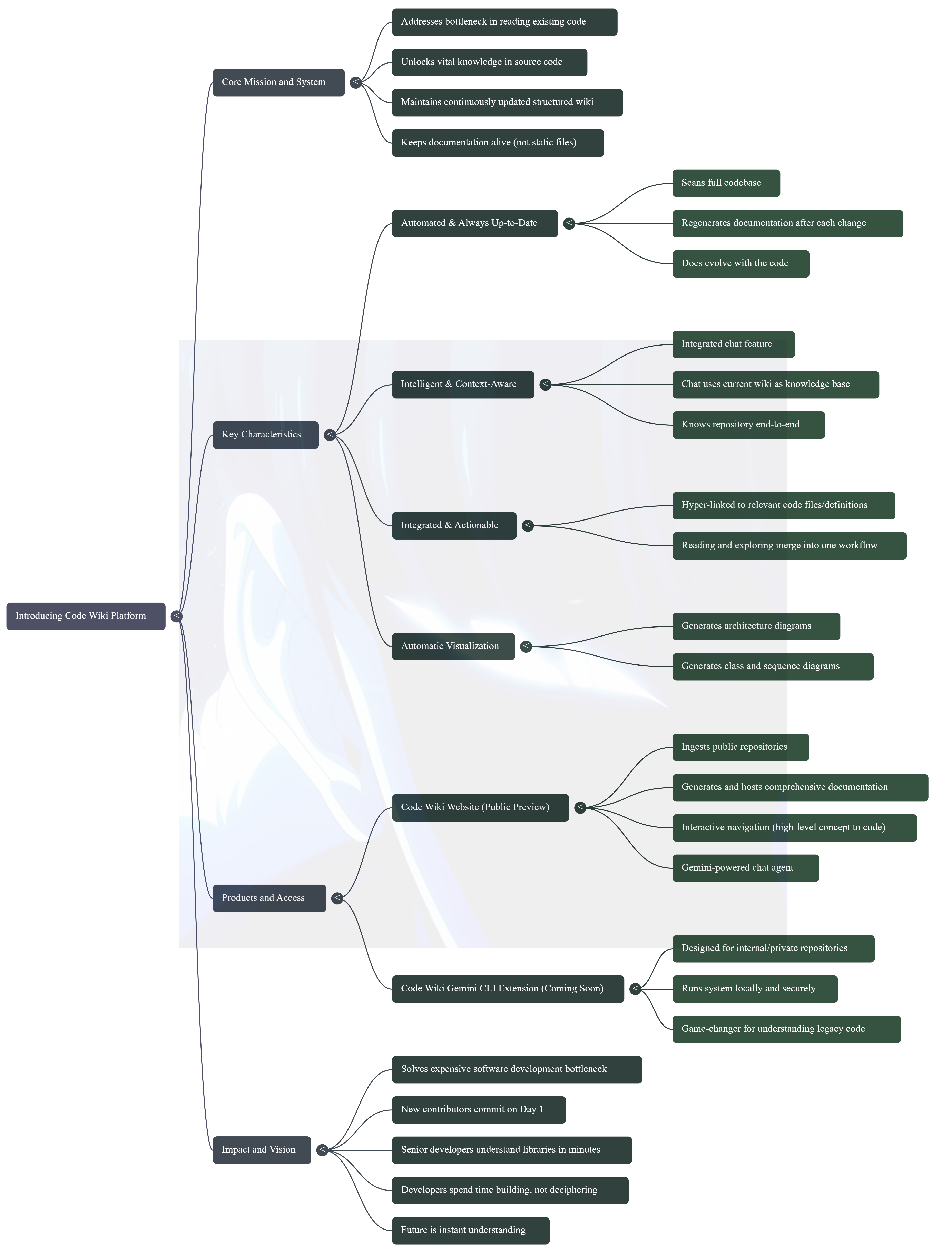
At Google, our mission is to organize the world’s information and make it universally accessible and useful. For developers, that means unlocking the vital knowledge currently buried in complex source code. Code Wiki was built to fulfill this mission by creating a “continuously updated, structured wiki for code repositories.” It transforms static code into living documentation to make code comprehension nearly instantaneous.
This is achieved through three core features: Code Wiki is Automated, Intelligent, and Integrated. Today, Google is launching the Code Wiki website in public preview, which ingests public repositories to generate this powerful, interactive documentation.
1. Automated & Always Up-to-Date: Documentation That Lives and Breathes
What “Automated” Means
The “Automated” feature means that Code Wiki does the work for you. It automatically scans the entire codebase and regenerates the documentation every single time the code changes. This ensures that the documentation is never stale or out of sync with the project. In short, the “docs evolve with the code.”
The Benefit for You: Trustworthy Information
For any developer, especially someone new to a project, this provides immense value. You can always trust that the documentation you are reading is accurate and reflects the current state of the code, eliminating the confusion and errors that come from relying on outdated manuals.
Key Automated Capabilities
Constant Regeneration: Documentation is completely rebuilt after each code change, guaranteeing it is always a perfect match for the codebase.
Automatic Diagrams: Code Wiki generates architecture, class, and sequence diagrams that visually represent the project’s structure and always match the code.
But having up-to-date information is only half the battle; Code Wiki also makes that information intelligent and interactive.
2. Intelligent & Context-Aware: Your Personal Code Expert
What “Intelligent” Means
Code Wiki’s intelligence builds directly on its automated foundation. The Gemini-powered chat agent uses the entire, always-current wiki—which is regenerated after every code change—as its exclusive knowledge base. This isn’t a generic AI trained on the open internet, but a specialized expert on your specific repository.
The Benefit for You: Specific Answers to Your Questions
This feature gives you a direct line to an expert on the code you’re working on. You can ask highly specific questions about a complex module or function and get context-aware answers, instantly bridging the gap between being confused and understanding the code.
The Core Concept: A Knowledgeable Chat Agent
The key to this feature’s power is its deep, focused knowledge of your project.
You’re not talking to a generic model but to one that knows your repo end-to-end.
Getting precise answers is powerful, and Code Wiki makes those answers immediately actionable by integrating them directly into your workflow.
3. Integrated & Actionable: From Reading to Exploring in One Click
What “Integrated” Means
“Integrated” means that every part of the documentation—from wiki articles to chat answers—is directly hyperlinked to the relevant code files, classes, and function definitions. This creates a powerful connection between the high-level explanation and the low-level implementation.
The Benefit for You: A Seamless Workflow
This deep integration means reading and exploring merge into one workflow. You no longer need to read about a concept on one screen and then manually hunt for the corresponding code in another.
4. Coming Soon: Code Wiki for Your Private Repositories
While the open-source ecosystem benefits greatly from this technology, it’s often our own private repositories that are the hardest to document. To address this, we are building a Gemini CLI extension for Code Wiki so teams can run the same system locally and securely on internal codebases, ensuring everyone has the ability to deeply understand the code they’re working on. You can join the waitlist for early access.
Conclusion: The Future is Instant Understanding
By weaving together automated, intelligent, and integrated features, Code Wiki directly tackles the bottleneck of reading and deciphering existing code. It creates an environment where documentation is a living, helpful partner rather than a static, outdated artifact.
The impact of this approach is significant for developers at all levels. As the creators note, “New contributors can make their first commit on Day 1, while senior developers can understand new libraries in minutes, not days.”
Developers should spend their time building, not deciphering.
The future of development is about instant understanding.
Start now at codewiki.google.